Summary:
You said yes to planning the church event. Maybe it was a fundraising carnival, a community block party, a VBS celebration, or a spring fair after First Communion season. Whatever the occasion, you’re now staring at a blank to-do list with a date circled on the calendar and a lot of questions. What permits do you actually need? Does the rental company need to provide insurance? How far out should you be booking entertainment? This guide answers those questions in plain terms — with Nassau County-specific details that generic checklists never bother to include. By the end, you’ll know exactly what to do and in what order.
Church Event Planning Checklist: What to Do Before You Book Anything
The biggest mistake church event committees make is jumping straight to vendors before sorting out the foundational logistics. Before you confirm a date or sign a contract, you need to know where the event is happening, whether that location requires a permit, and what insurance documentation your venue will ask for. In Nassau County, those questions have specific answers — and the answers affect everything else on your list.
Start with your venue. If you’re hosting on church property, your permitting needs are minimal, though you may still need a sound permit from your local precinct for amplified music. If you’re planning to use a Nassau County park — Eisenhower Park in East Meadow, Cantiague Park in Hicksville, Nickerson Beach — you’ll need a Special Event Permit from the Nassau County Department of Parks, Recreation, and Museums. Applications go to [email protected] using their official event checklist, and insurance documentation from every vendor is required. That last part matters more than most people realize.
Do You Need a Permit for a Church Event in Nassau County?
The short answer is: it depends on where you’re holding it and what you’re doing there. Events on private church property in an incorporated village or town typically don’t require a county-level special event permit, but you may still need to notify your municipality, pull a food service permit if you’re selling or distributing food, and secure a sound permit for amplified music. These requirements vary by town, so it’s worth a quick call to your local village hall or town clerk’s office before you assume you’re in the clear.
For events in Nassau County parks, the permit process is more formal. You’ll submit an application to the Department of Parks, Recreation, and Museums, and you’ll need to provide proof of liability insurance — not just your own, but from any vendor bringing equipment onto the site. That means your bounce house rental company, your tent company, your food vendor. All of them need to supply a Certificate of Insurance that names your church and the county as additional insured parties. If a vendor can’t or won’t provide that documentation, they shouldn’t be on your vendor list.
If you’re planning a block party on a public street — common in communities like Massapequa, Wantagh, and Seaford — you’ll need a permit from your local police precinct or village office. In Long Beach, for example, block party applications go directly to the Long Beach Police Department and must be submitted at least ten days before the event, with a designated Block Party Coordinator and signatures from neighboring residents. Other Nassau municipalities have similar processes, so check with your local authority early. Waiting until three weeks out is how permits get missed.
The general rule for timeline: start the permitting process at least six to eight weeks before your event date, and start planning the overall event at least three to four months out. Popular spring and summer dates — especially May and June, which overlap with communion season in Nassau County’s heavily Catholic communities — fill up fast for both permits and vendor availability.
What to Look for in a Bounce House Rental Company for a Church Event
This is where a lot of church event committees get burned. The inflatable rental market has a low barrier to entry, which means there are legitimate, professional operators — and there are people running a business out of a storage unit with a bounce house they bought used off Craigslist. The difference matters enormously when you’re hosting an event for families and children, and when your venue is requiring insurance documentation.
The first thing to ask any rental company is whether they can provide a Certificate of Insurance naming your church and venue as additional insured. A reputable company does this routinely. If a vendor hesitates, can’t explain what a COI is, or tells you their insurance “covers everything,” move on. Their policy protects them — not your organization — unless the COI is structured correctly.
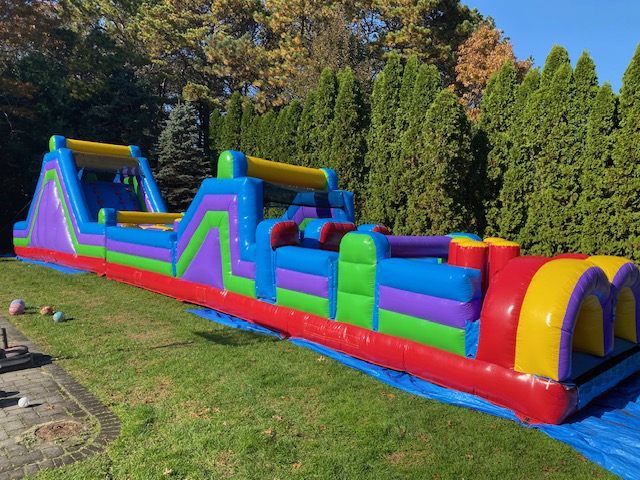
Beyond insurance, look for commercial-grade equipment. Residential inflatables from big-box stores are not built for extended public use, higher occupant loads, or the kind of all-day operation a church fundraiser requires. Commercial-grade units are manufactured to ASTM industry standards and are rated for the demands of community events. We only carry commercial-grade inflatables — every unit we own was purchased brand new, and we clean and sanitize after every single rental.
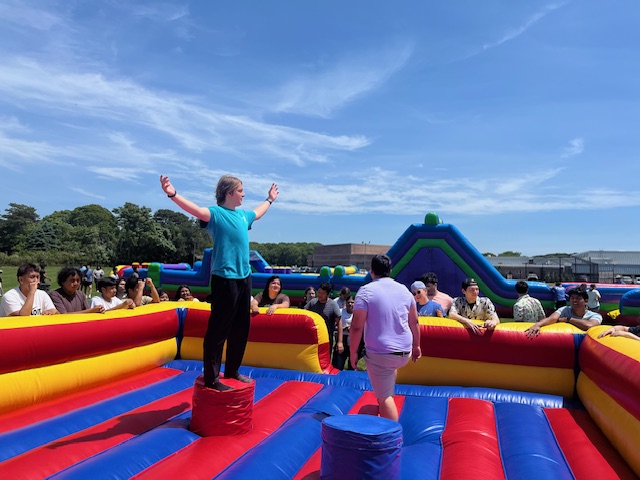
For large church events, staff matters too. When you have 200 kids cycling through a bounce house, obstacle course, and water slide, you need trained attendants managing each unit — not a volunteer from your committee who’s also trying to run the ticket table. We provide on-site staff for church events, block parties, and community fundraisers so your team can focus on guests, not equipment. We’re also a member of SIOTO, the Safety Inflatable Operators Training Organization, which means our setup, anchoring, and safety protocols follow industry standards. On Long Island, where coastal winds can pick up quickly, that’s not a formality — it’s a real operational consideration.
Fundraising Event Checklist: How to Turn a Church Carnival Into a Revenue Driver
A church fundraiser works best when the entertainment does double duty — it brings people in and keeps them there long enough to spend money. That means your entertainment choices aren’t just about fun. They’re about attendance, dwell time, and the overall feel of the event. A well-run carnival with a bounce house, obstacle course, carnival games, and a concession stand gives families a reason to stay for three hours instead of forty-five minutes. That difference shows up directly in your revenue.
The most efficient ticketing model for a church carnival is a wristband system — one price at the entrance for unlimited access to all inflatables and activities. It simplifies the financial transaction, reduces lines at individual stations, and makes the event feel more generous and welcoming to families. Per-activity ticketing works too, especially if you want to create separate revenue streams for premium activities, but it adds complexity for your volunteers.
How Custom Branding Can Elevate Your Church Fundraiser
Most church fundraising carnivals look like every other church fundraising carnival. Generic inflatables, folding tables, handwritten signs. That’s fine — it works. But if you want to attract sponsors, charge a higher ticket price, and create an event people talk about afterward, visual identity matters more than you’d think.
We offer custom branding options that most rental companies don’t. Our in-house graphics team can wrap arcade machines, claw machines, and other equipment with your church’s logo, your event name, or a sponsor’s branding. It’s the kind of detail that makes an event look intentional and professional — and it gives sponsors a tangible reason to contribute, because their name is actually visible on the equipment, not just on a banner in the corner.
For larger fundraisers, a custom-branded mini golf course is one of the most effective tools we’ve seen for this. Each hole can be themed around your event, your church’s mission, or a sponsor. It draws families in, keeps them engaged for a long time, and photographs well — which matters for social media and for showing donors what their money supported. We’ve built fully custom mini golf installations for major brand activations, and the same concept translates directly to church and community events.
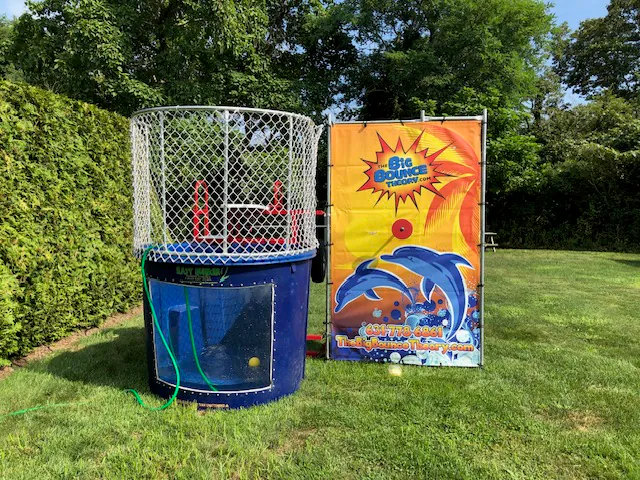
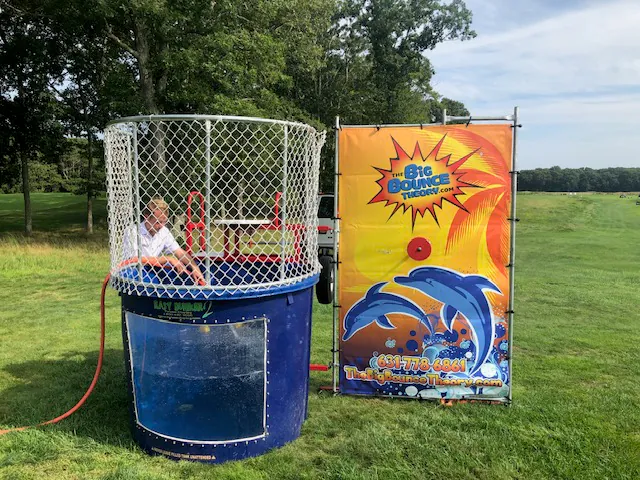
Beyond branding, inventory breadth is a real advantage for fundraising events. Instead of coordinating four or five different vendors — each with their own contract, COI, and delivery window — you can source bounce houses, obstacle courses, carnival games, concession machines, tents, tables, and chairs from us directly. Fewer vendors means fewer variables and far less for your committee to manage on event day.
Block Party Planning Checklist for Nassau County Communities
Block parties are one of the most common church-sponsored community events on Long Island, and they come with their own specific logistics. If your church is organizing a block party on a public street in Nassau County — or sponsoring one in partnership with a neighborhood association in Bellmore, Seaford, Wantagh, or anywhere else across the county — the planning checklist looks a little different from a private event on church property.
First, the permit. As mentioned earlier, block parties on public streets require approval from your local municipality or police precinct. In most Nassau County communities, the process involves designating a Block Party Coordinator, gathering signatures from residents on the affected block, and submitting the application within your municipality’s required window. Some towns want thirty days’ notice. Others, like Long Beach, require ten. Don’t assume — confirm with your local authority early, because a missing permit can shut down the event on the day regardless of how much planning went into it.
Once permits are handled, the logistics of a street-based event have some specific wrinkles. Power access is one of them. Inflatables require a dedicated electrical circuit — typically a 20-amp circuit per unit — and if you’re on a residential street, you’ll need to plan carefully for where power is coming from. We assess power requirements during setup and can advise on generator needs if existing outlets aren’t sufficient. Generators over a certain capacity may also require a separate permit in some Nassau municipalities, so that’s worth confirming ahead of time.
Space measurement is another area where volunteer event planners frequently underestimate the complexity. A standard bounce house needs a footprint of roughly 15 by 15 feet, plus clearance on all sides and overhead. An obstacle course or water slide needs significantly more. On a residential street, that space exists — but it needs to be mapped out in advance so you’re not discovering on setup day that the equipment doesn’t fit around a parked car or a utility pole. We handle the measurements and placement assessment as part of our setup process, which is one of the reasons organizations that have worked with us tend to come back year after year.
Ready to Plan Your Nassau County Church Event the Right Way?
Church event planning in Nassau County has real moving parts — permits, insurance documentation, vendor vetting, space logistics, and fundraising strategy — and the volunteer committees doing this work deserve a resource that actually addresses those specifics instead of offering generic advice that could apply anywhere.
The short version of this checklist: start three to four months out, sort permits before you book vendors, require a COI from every vendor you hire, and choose entertainment that keeps families engaged long enough to make your fundraising goal worthwhile. Get those fundamentals right, and the rest of the event falls into place.
If you’re planning a church event, block party, or fundraising carnival in Nassau County and want to talk through what the entertainment setup could look like, reach out to The Big Bounce Theory. We’ve been doing this on Long Island since 2007, and we’re happy to help you figure out what makes sense for your event, your space, and your goals.