Summary:
You’re planning an event in Nassau County and you want something that actually holds people’s attention — not a bounce house that kids cycle through in 30 seconds and forget. An inflatable obstacle course brings something different: real competition, real energy, and the kind of moment where adults and kids alike are cheering each other on at the finish line.
But before you book anything, there are real questions worth answering. What size fits your space? What does safe setup actually look like? And how do you tell the difference between a legitimate operator and someone running five-year-old equipment out of a storage unit? That’s exactly what this guide covers.
Inflatable Obstacle Course Rental: What You're Actually Getting
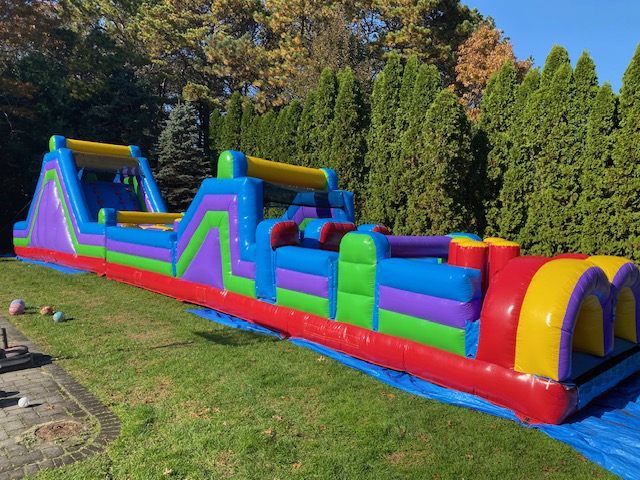
An inflatable obstacle course isn’t just a bigger bounce house. It’s a structured challenge — tunnels to crawl through, pop-up obstacles to navigate, climbing walls to scale, and a slide waiting at the finish. The dual-lane design is what makes it genuinely fun: two people racing side by side, start to finish, while everyone else watches and waits their turn.
At a busy party or school event, that format moves fast. Each run takes roughly 20 to 30 seconds, which means a two-hour rental can put hundreds of guests through the course without anyone standing around bored. The competitive element also makes it work across age groups — younger kids love the physical challenge, teenagers get into the racing, and adults almost always end up on it before the day is done.
Bouncy Obstacle Course Rental: How to Choose the Right Size for Your Nassau County Space
Size is where a lot of Nassau County renters run into trouble. Long Island lots — especially in communities like Oceanside, Elmont, Rockville Centre, and New Hyde Park — tend to run smaller than what you’d find further east in Suffolk. A 60-foot course that looks great in a product photo might not have a realistic home in your backyard, and figuring that out after you’ve booked is a frustrating situation.
Obstacle courses start under 30 feet for compact residential setups and scale up past 110 feet for large outdoor events. Width typically runs 10 to 20 feet, and height can reach 15 to 20 feet on units with climbing walls and elevated slides. That last number matters especially if you’re considering an indoor setup — a gymnasium or event hall needs at least 15 feet of overhead clearance to accommodate most full-size courses.
For outdoor setups, surface type is the other variable to sort out early. Grass is the ideal surface for staking and anchoring. Hard surfaces like asphalt or concrete are workable with sandbag weights, but it’s worth confirming that with us before the event. Setup on uneven ground or near landscaping features can complicate placement, so a quick conversation about your specific yard goes a long way.
If you’re hosting at a Nassau County park — Eisenhower Park in East Meadow, Nickerson Beach, or Merrick Road Park, for example — you’ll also need to account for permit requirements and the physical layout of the space you’ve reserved. Those venues can accommodate larger multi-unit setups, but they come with their own logistics. We’ve done this before in Nassau County and know what to expect.
The honest answer on sizing is this: don’t guess. Share your yard dimensions, describe your surface, and let us help you match the right unit to your actual space. It takes five minutes and saves you a real headache.
What Safe Inflatable Setup Actually Looks Like — and Why It Matters Here
Safety in the inflatable rental industry isn’t a given — it varies significantly depending on who you’re renting from. The difference between a properly set up commercial-grade obstacle course and a residential unit dropped in a driveway by an uninsured operator is substantial. It’s the difference between professionally anchored, ASTM F2374-compliant commercial equipment and something built to a lower standard that may have been in service for years.
A 2015 study by the Center for Environmental Health found that 50% of tested bounce houses had lead levels above safe limits — some reaching ten times the Consumer Product Safety Commission’s maximum threshold. That’s a statistic most people don’t know, and it’s exactly why the age and quality of the equipment you rent should be a real part of your decision, not an afterthought.
We follow established protocols: proper ground anchoring with stakes on grass or sandbag weights on hard surfaces, weather monitoring with clear wind thresholds for deflation, power management across dedicated circuits, and trained staff who know how to handle setup and supervision from start to finish. For larger events — school field days, corporate picnics, community festivals — we provide staffed attendants throughout the event, not just during setup.
SIOTO membership is one of the clearest signals that an operator takes this seriously. The Safe Inflatable Operators Training Organization has been the industry’s leading safety certification body for over 18 years, covering everything from anchoring and supervision protocols to emergency response. It’s a verifiable credential, not a logo anyone can copy-paste onto a website.
For events at Nassau County parks or school district facilities, there’s another layer: you’ll need a Certificate of Insurance with the venue or organization named as additionally insured. Many parks and school administrations in Nassau County require this documentation before any inflatable can be set up on their property. We can produce that paperwork quickly and correctly. If your rental company can’t, you’re looking at a venue rejection on the day of your event.
Obstacle Course Bounce House vs. Standalone Course: Which One Fits Your Event?
It’s a question that comes up often, and the answer depends on your guest list and how you want the day to flow. A standalone inflatable obstacle course is built entirely around the challenge — every element is designed to move participants from start to finish as fast as possible, with nothing else pulling their attention. It’s the right call when competition and high energy are the main goal.
A combo bounce house that includes obstacle elements gives you more variety in a single footprint. Guests can bounce, climb, slide, and work through challenge sections, but the experience is less structured. For younger kids at a birthday party, that flexibility can actually be a better fit. For a school field day in Syosset or a community event in Massapequa where you want a clear, timed race format, the standalone course tends to win.
An obstacle course handles the high-energy crowd well, but not every guest wants to run a timed race. Giant connect 4 is one of the most consistently popular add-ons for exactly that reason — it’s accessible, competitive in a completely different way, and draws in guests who might not be ready to tackle a climbing wall. Strategy over speed, and it works for every age group.
For corporate events in the Garden City or Uniondale business corridor, giant lawn games like connect 4 also serve a specific purpose: they create natural gathering points where people actually talk to each other. That’s harder to engineer with a bounce house. A well-placed giant game next to an obstacle course gives you two distinct activity zones, which keeps the energy distributed and the event feeling fuller.
The same logic applies to school carnivals and community festivals. Nassau County has 56 school districts, and PTA-organized events are one of the busiest segments of the summer rental season. When you’re trying to keep 200 kids entertained across a three-hour field day, variety matters. An obstacle course handles throughput; giant connect 4 and carnival game booths handle the in-between moments.
For corporate clients specifically, there’s another angle worth knowing: we can custom-brand interactive games and obstacle courses with company logos and colors using vinyl wraps. That turns a fun event into something that actually reinforces your brand — useful for client appreciation days, employee events, and trade show activations where you want the experience to feel intentional, not just rented.
Building a complete event package — obstacle course, giant games, concessions, tents, tables — from a single vendor simplifies everything. One delivery, one setup crew, one point of contact when something needs to be adjusted. For events at Nassau County parks where logistics are already complicated by permit requirements and shared spaces, that simplicity has real value.
Frequently Asked Questions About Inflatable Obstacle Course Rentals in Nassau County
**Can adults use inflatable obstacle courses?** Yes, and they usually end up being the most enthusiastic participants. Our commercial-grade obstacle courses are built to handle adult weight and use. Corporate team-building events, adult birthday parties, and community festivals across Nassau County regularly feature obstacle courses as the centerpiece activity precisely because they work across age groups. The dual-lane racing format tends to bring out the competitive side of people who thought they were just there to watch.
**How much power does an inflatable obstacle course need?** Most units require one to two dedicated 20-amp circuits. For backyard events in communities like Levittown, Valley Stream, or Freeport, that typically means running a heavy-duty extension cord from your home’s electrical panel to the setup location. Larger multi-unit setups — common at school events and park festivals throughout Nassau County — may require a generator. We’ll walk you through the power requirements for your specific setup before the event day.
**Do I need a permit to set up an inflatable at a Nassau County park?** In most cases, yes. Nassau County parks and many individual municipalities require advance permits for commercial inflatables on public property. You’ll also need a Certificate of Insurance naming the park or municipality as additionally insured. The permitting process and lead time varies by location — Eisenhower Park, for example, has its own reservation and approval process for large events. We’re familiar with Nassau County venues and can provide proper insurance documentation quickly, which will save you significant stress.
**What if my backyard isn’t big enough?** More Nassau County yards can accommodate an obstacle course than people expect, especially with shorter units starting under 30 feet. The best approach is to measure your available space — length, width, and any overhead obstructions — and share those dimensions when you call. We’ve helped homeowners in tight Nassau County yards find the right fit more times than we can count. If your space genuinely won’t work, we’ll tell you that too.
**How far in advance should I book?** For peak season weekends — Memorial Day through Labor Day — booking four to six weeks out is a safe target. July 4th and Labor Day weekends in Nassau County fill up fast, and availability gets thin quickly once the season starts. If you have a specific date in mind, the earlier you lock it in, the better.
Choosing the Right Inflatable Obstacle Course Rental in Nassau County, NY
The right obstacle course rental comes down to a few things that are worth taking seriously: equipment that’s actually in good condition, a company that carries proper insurance and can document it, professional setup from people who know what they’re doing, and enough inventory variety to build a complete event rather than a single attraction.
Nassau County has a lot of options. Not all of them will show up on time, produce a COI when your venue asks for one, or arrive with equipment that looks the way it did in the photos. Those details matter more than most people realize until something goes wrong.
If you’re planning a birthday party in Massapequa, a school carnival in Syosset, a block party in Rockville Centre, or a corporate event anywhere across Nassau County, we’ve been handling events like yours since 2007. Give us a call and tell us what you’re working with — we’ll help you figure out the rest.