Summary:
You’ve decided a dunk tank is the move for your event. Smart call. Now you’re searching around, and you’re already running into your first problem — half the companies call it a dunk tank, half call it a dunking booth, and you’re not entirely sure if those are the same thing or two different products with different price points. They’re the same thing. We’ll get into that. But that’s just the first of several questions most people have before they book, and most rental company pages don’t bother answering them. This one will.
Dunk Tank vs. Dunking Booth Rental: Is There Actually a Difference?
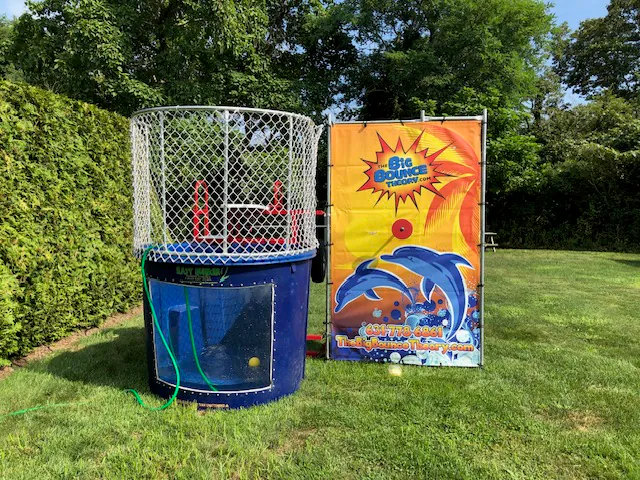
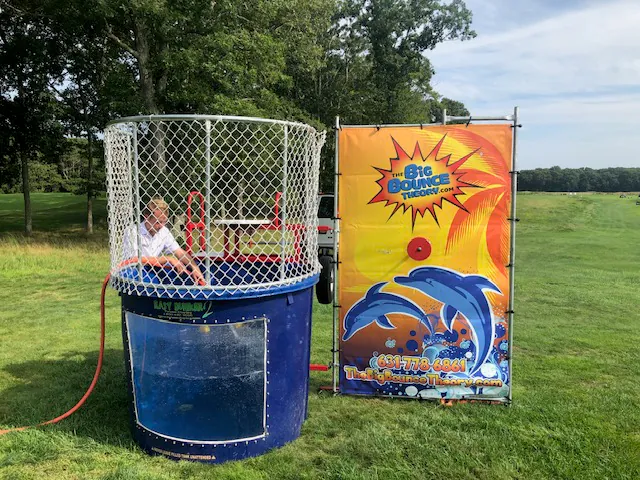
No. A dunk tank and a dunking booth are the same product — a large water-filled tank with a suspended seat above it. Someone climbs in, the crowd throws balls at a target, and when they hit it, the seat drops and the person goes in. The terminology is purely regional and generational. Some people grew up calling it a dunking booth; others have always said dunk tank. Either way, you’re looking for the same rental experience.
This matters more than it sounds. If you’re a school administrator searching “dunking booth rental” and landing on pages that only use the phrase “dunk tank,” it’s easy to second-guess whether you’re in the right place. You are. Both terms point to the same piece of equipment, and when you call us, you don’t need to worry about which word you use.
What Does a Dunk Tank Actually Include When You Rent One?
A commercial-grade dunk tank rental includes the tank itself, delivery to your event location, setup, and breakdown at the end. What it does not include — and this is worth confirming with any rental company before you book — is the water. You’ll need access to a standard garden hose and an outdoor spigot. The tank takes approximately 45 to 60 minutes to fill, so that’s time you’ll want to account for in your setup window, not your event window.
The tank itself requires a footprint of roughly 4 feet by 8 feet, plus at least 15 to 20 feet of clear space in front of the target for participants to throw from. That’s the minimum. In practice, you want a bit more buffer, especially at larger events where you’ll have a crowd gathered. A firm, level surface — grass, concrete, or asphalt — works well. Soft, uneven, or sloped ground creates stability issues, so it’s worth scoping your location in advance.
One thing that surprises first-time renters: no electricity is required. Dunk tanks are entirely water-powered, which makes them ideal for Nassau County parks, open fields, and venues that don’t have easy power access. If you’re setting up at a park, that’s one less thing to coordinate.
The person sitting in the seat should be at least five feet tall and under the standard 250-pound weight limit. That covers most adults comfortably, which is part of why dunk tanks work so well at adult events — corporate picnics, block parties, fundraisers — not just kids’ parties. Adult supervision is required at all times, and the commercial-grade units we use include safety nets, textured ladder and steps, and a locking mechanism that prevents the seat from dropping while someone is climbing in.
How Far in Advance Should You Book a Dunk Tank Rental in Nassau County?
Earlier than you think. Nassau County’s outdoor event season runs from late May through early September, and that window is compressed enough that popular summer weekends book out four to eight weeks in advance. If your event is tied to a fixed date — a school field day, a community festival, a corporate picnic — you don’t have flexibility to wait and see.
School events in particular tend to cluster in predictable windows. End-of-year field days and spring carnivals fill up fast across Nassau County’s 56 public school districts, which is one of the highest concentrations in the state. If you’re a PTA chair or school administrator, getting your date on the calendar six to eight weeks out is a reasonable target. Corporate event planners coordinating summer picnics often book even earlier because they’re working around venue availability, catering, and other vendor schedules simultaneously.
The practical advice: once you’ve confirmed your venue and your date, make the rental call. Availability is the one thing you can’t negotiate after the fact. If you’re unsure about other details — exact headcount, whether you need additional equipment — those conversations can happen later. Securing the date is the move that matters first.
If you’re planning an event in a Nassau County park, there’s an additional layer to account for. Most municipalities require a Certificate of Insurance from the rental company, with the park or municipality listed as an additional insured on the policy. This isn’t unusual — it’s standard practice at venues like Eisenhower Park in East Meadow, NY, which is one of the most common event sites we work with for larger setups. We handle the COI process regularly, but you’ll want to confirm the specific requirements with your park’s permit office early, because processing times vary.
What Event Planners in Nassau County Actually Want to Know About Dunk Tank Rentals
The questions that matter most to event planners aren’t usually about the equipment itself — they’re about what happens when something goes sideways. What if it rains? What if the venue has a permit requirement you didn’t know about? What if the company doesn’t show up? These are the right questions, and they’re worth asking directly before you commit to any rental company.
A few things to look for: proof of general liability insurance (and the ability to add your venue as an additional insured), a clear rain and cancellation policy, and confirmation that the company uses commercial-grade equipment rather than consumer-grade units. The difference matters — commercial tanks are built to ASTM amusement-device standards, which govern everything from structural integrity to the locking seat mechanism. Consumer-grade tanks are not held to those standards.
What to Ask Any Dunk Tank Rental Company Before You Book
Start with insurance. Ask for proof of general liability coverage and confirm they carry workers’ compensation for their employees — both are required under New York State regulations for inflatable rental businesses. If your event is in a park, school, or corporate venue, ask whether they can add the location as an additional insured on their policy. Many venues in Nassau County require this as a condition of approval, and companies that can’t provide it are disqualified before the conversation gets any further.
Ask about the equipment itself. Is it commercial-grade? Has it been inspected? Is it cleaned between rentals? These aren’t nitpicky questions — they’re the baseline for any company operating professionally in this space. Commercial-grade dunk tanks built to ASTM standards include features like safety nets, textured steps, and locking seat mechanisms. If a company can’t tell you what standard their equipment meets, that’s a meaningful data point.
Ask what’s included in the rental. Delivery and setup should be standard. Confirm whether breakdown and pickup are included as well, and clarify who is responsible for filling the tank. Most rental companies require the customer to provide the water source — a garden hose connected to an outdoor spigot — but you’ll want that confirmed in writing so there are no surprises on event day.
Finally, ask about attendants. For school events, corporate events, camps, church functions, block parties, and park events, we provide attendants for our equipment. That’s not universal across the industry. If you’re running an event where you can’t spare a staff member to supervise the dunk tank, knowing whether an attendant is included changes your planning significantly. Don’t assume — ask.
Why Dunk Tanks Work So Well at Nassau County School and Fundraiser Events
Dunk tanks have a specific quality that most carnival games don’t: they create a moment. When the principal finally hits the water, or the coach goes under for the third time, the crowd reacts in a way that a ring toss or a balloon dart game never quite generates. That shared reaction is what makes dunk tanks such a reliable fundraiser — people will pay to throw the ball, and they’ll pay more if the person in the seat is someone they’re genuinely motivated to drench.
For Nassau County school events and community fundraisers, this translates into real revenue. The format is simple: participants pay a set amount per throw or per round, and the proceeds go directly to the cause. PTAs, civic organizations, and school booster clubs have used this format for decades because it works. It’s engaging, it’s competitive, and it scales easily — a single tank can run for hours with a rotating cast of willing targets.
From a logistics standpoint, fundraiser events benefit from a few specific things. A clear, visible location within the event footprint draws foot traffic organically — you don’t need to announce it if people can see and hear it. A table nearby for collecting payments keeps the line moving. And having a rotation of “victims” lined up in advance — teachers, administrators, coaches, local figures — keeps the energy consistent throughout the event rather than dying down between rounds.
For events in Nassau County parks, confirming the COI requirement with the parks department before your event date is especially important. Towns like East Meadow, NY, Wantagh, NY, Seaford, NY, and Merrick, NY each have their own parks departments with their own permit processes, and lead times vary. Getting that documentation squared away early removes the single most common logistical obstacle for park-based events. We’ve worked through this process many times at venues across Nassau County and can help you understand what’s typically required.
Ready to Rent a Dunk Tank for Your Nassau County Event?
The logistics aren’t complicated once you know them. You need a flat surface, a garden hose, 15 to 20 feet of throwing clearance, and a rental company that shows up on time with commercial-grade equipment and the insurance documentation your venue requires. That’s the whole checklist.
What trips people up isn’t the equipment — it’s the details they didn’t know to ask about until it was too late. Booking too close to a summer weekend. Assuming the park permit would sort itself out. Not confirming who fills the tank. These surprises are avoidable.
If you’re planning an event in Nassau County and want to talk through the specifics — venue requirements, setup timing, what else might work alongside the dunk tank — reach out to The Big Bounce Theory. We’ve been doing this on Long Island since 2007, and we’re easy to talk to.