Summary:
Field day planning usually starts the same way — someone gets handed the responsibility in February, searches for game ideas, and finds a list that’s perfectly fine but doesn’t answer the real question: how do you actually pull this off for 400 kids, across 12 stations, with a handful of volunteers and no margin for things to go sideways?
The game ideas are the easy part. What makes or breaks a field day is the planning behind them — what you’re sourcing, from whom, and whether it shows up on time and in one piece. This guide covers both. Fifteen games that genuinely work for elementary school field days, plus the logistical reality that most planning resources quietly ignore.
Elementary Field Day Ideas That Work for Every Grade Level
The trickiest part of planning a K–5 field day isn’t picking games — it’s picking games that work for a kindergartner and a fifth grader at the same event. What thrills a ten-year-old can overwhelm a five-year-old, and what holds a younger student’s attention might bore an older one before the rotation even ends.
The solution most experienced field day organizers land on is a tiered approach: a few high-energy anchor stations that draw the longest lines and define the day, a solid middle tier of team challenges and relay races, and a handful of lower-intensity activities that serve as natural rest stations between the bigger ones. That structure keeps the energy moving without burning anyone out — and it gives you a defensible answer when the principal asks how you’re keeping things age-appropriate.
The Anchor Stations: What Kids Actually Remember
Every field day has two or three stations that kids are already talking about at breakfast. These are your anchors — the ones that draw the longest lines, generate the most noise, and set the tone for the whole day. If these go well, the rest of the event feels like a success even if a few other stations fall flat.
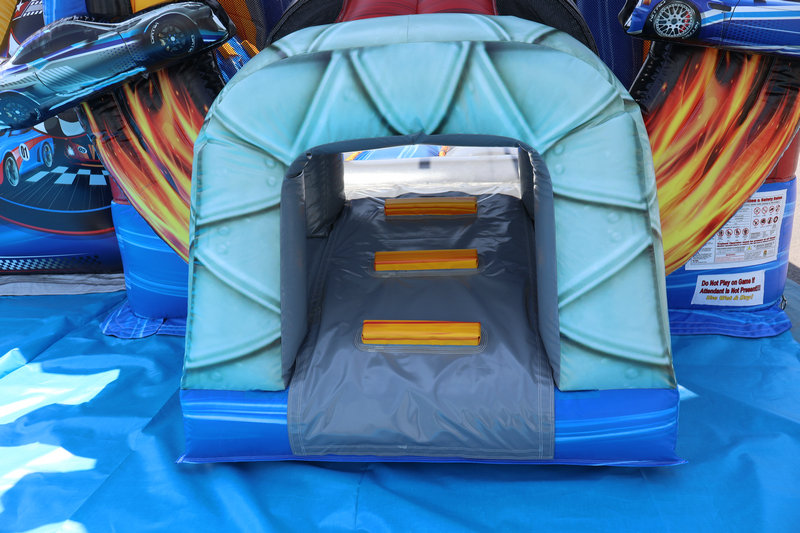
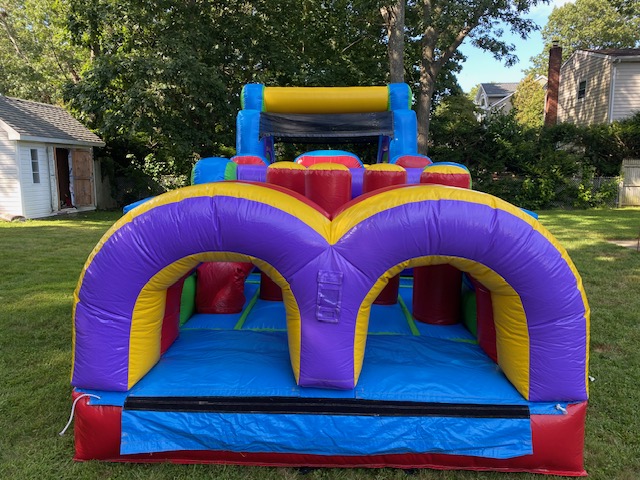
Inflatable obstacle courses are consistently the highest-engagement station at elementary school field days. They’re competitive in a way kids respond to naturally — two students racing side by side through tunnels, over climbing walls, and down slides — and they scale well across age groups because the challenge is physical and self-paced. Older students push harder; younger ones still love it. We regularly bring obstacle courses to school field days across Nassau County, from Massapequa to Syosset, and the line rarely drops below ten kids deep.
The dunk tank is the other anchor that earns its spot every single time, especially when a teacher or principal climbs in. There’s something about it that unifies the whole school — every grade level understands the concept, everyone wants a turn, and the moment someone actually goes in is the loudest moment of the day. It’s also genuinely simple to run, which matters when your volunteer pool is stretched thin.
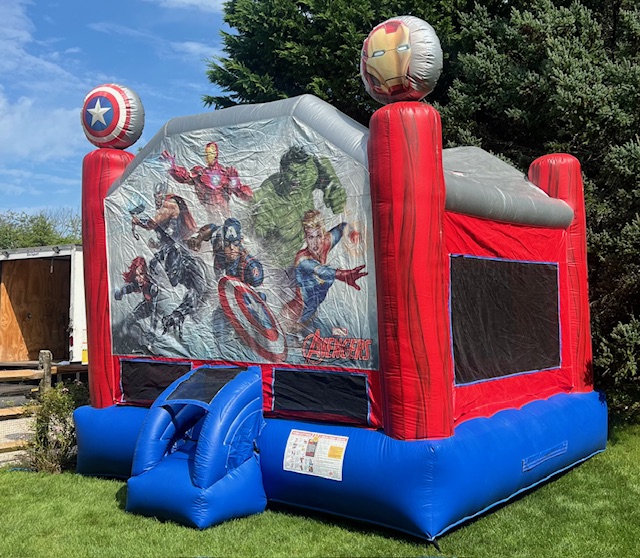
Rounding out the anchor tier: a large inflatable water slide if your event runs into late May or June heat, and a bounce house sized for the younger grades. These aren’t supplementary — they’re the reason kids remember the day. Everything else fills the rotation.
Mid-Tier and Filler Games That Keep the Rotation Moving
Once your anchors are set, the rest of the station lineup is about variety and flow. You need activities that are easy to supervise, quick to reset between groups, and engaging enough that kids aren’t just standing around waiting for their next turn at the obstacle course.
Tug of war is the classic for a reason — it requires nothing but a rope and a marked center line, it works for any age when you match groups by size rather than grade, and it generates immediate team energy. Sack races and three-legged races are similarly low-equipment and high-fun, though they work better as scheduled heats than open-rotation stations. Hula hoop relays, where students pass a hoop down a linked chain without breaking hands, are a reliable crowd-pleaser that also works as a classroom warm-up if you want to preview it beforehand.
Carnival-style game booths — ring toss, ball toss, duck pond for the younger grades — serve a specific and important function in the rotation: they’re rest stations that don’t feel like rest stations. Kids are still engaged, still competing, still winning small prizes, but the physical demand is minimal. This matters for younger students who need a break between high-energy stations, and it’s a natural fit for students with physical limitations who might otherwise sit out the more demanding activities.
Water balloon stations and sponge relays are perennial favorites for late-May events when the weather cooperates. They’re easy to set up, require minimal equipment, and give students a sensory experience that’s genuinely different from every other station. The one logistical note: designate a specific cleanup volunteer for these stations, because wet grass and a few hundred kids moving quickly is a combination that deserves some attention.
Giant Jenga, oversized Connect Four, and other lawn game formats have grown in popularity at school field days over the last several years. They’re quieter stations that work well for students who prefer less physical competition, and they tend to draw a different subset of kids than the high-energy stations — which is exactly what you want in a well-balanced rotation.
How Nassau County Schools Actually Book Field Day Equipment
Here’s the part most field day planning guides skip entirely: by the time a lot of Nassau County schools start making vendor calls in April or May, the equipment they actually want is already reserved. Obstacle courses, dunk tanks, and large water slides book out fast in the spring — not because vendors are trying to create urgency, but because the field day window on Long Island is genuinely compressed. Most schools are targeting the same three or four weeks in late May and early June, and the inventory only goes so far.
The schools that have the smoothest field days are the ones that start vendor conversations in February or March, lock in their dates early, and aren’t scrambling to piece together a program from whatever’s left. It’s a simple logistical reality, but it makes an enormous difference in what your event can actually include.
Why a Single Vendor Makes Field Day Logistics Manageable
Managing a school field day with five different vendors is five times the risk. One shows up late, one sends the wrong size unit, one doesn’t have their insurance paperwork ready for the district office — any one of those problems can cascade into a genuinely difficult morning when you have 400 students already outside and waiting.
The schools that have the most consistent field day experiences are the ones that consolidate as much as possible under a single vendor. When you can get your obstacle course, your dunk tank, your carnival game booths, your concession machines, and your event essentials — tents, tables, chairs — from one company, you’re making one call, coordinating one delivery, and holding one vendor accountable. That’s a fundamentally different logistical situation than managing a patchwork of separate providers.
We’ve been serving school field days across Nassau County since 2007, and the requests we hear most often from returning clients aren’t about specific games — they’re about making the whole day easier to run. Schools in Garden City, Levittown, Oceanside, and Rockville Centre come back year after year partly because they know what they’re getting: equipment that arrives on time, in the condition it was described, with the paperwork the district needs already in hand. That consistency is worth more than any individual game idea.
What Schools Need to Know Before Booking a Field Day Vendor in Nassau County
Nassau County school districts have specific requirements for outside vendors, and it’s worth understanding them before you start making calls. Most districts require commercial general liability insurance from any vendor operating on school grounds, with a certificate of insurance that names the school district as an additional insured. Some districts have minimum coverage thresholds. If a vendor can’t provide that documentation quickly and cleanly, they’re not a viable option for a school event regardless of how good their equipment looks.
New York State also has regulations governing the operation of commercial inflatables at public events. Reputable vendors register their equipment, maintain inspection records, and operate in compliance with state amusement ride requirements. This isn’t fine print — it’s the baseline that separates vendors who can legally and safely serve a school event from those who can’t. When you’re responsible for the safety of several hundred students, that distinction matters.
We’re fully licensed and insured, and we’ve been through the documentation process with Nassau County school districts many times. If your district office has specific requirements for the certificate of insurance or needs additional paperwork, that’s a routine conversation for us — not an obstacle. The goal is to make the approval process as straightforward as possible so the planning energy goes into the event itself, not into chasing paperwork.
One more practical note for Nassau County field days specifically: Long Island’s late May weather can shift quickly, particularly near the coast. If you’re planning an outdoor event, it’s worth asking your vendor about their weather policy upfront — what happens if conditions deteriorate, what the rescheduling process looks like, and whether any of their inventory has covered or sheltered options. Having that conversation in March is much easier than having it the week of the event.
How to Plan a School Field Day That Actually Goes Smoothly
A good field day comes down to three things: the right mix of activities, reliable equipment, and a plan that doesn’t depend on everything going perfectly. The game ideas in this guide give you a solid foundation — anchor stations that kids genuinely get excited about, mid-tier activities that keep the rotation moving, and lower-intensity options that make sure every student has a place in the day.
The logistics layer is what most planning resources leave out, and it’s where most field days either succeed or quietly fall apart. Starting your vendor conversations in February, consolidating your equipment under one provider, and making sure your documentation is squared away before the district asks for it — those aren’t glamorous planning steps, but they’re the ones that determine whether the day runs the way you pictured it.
If you’re organizing a field day for a Nassau County school and want to talk through what a full station lineup might look like, we’re a good place to start that conversation.