Summary:
You’ve got the guest list, the date, and a backyard that’s finally getting some use. Now you’re looking at inflatable rentals, maybe a dunk tank or obstacle course, and wondering if there’s anything you’re supposed to do before the truck shows up.
The honest answer: sometimes yes, and it depends on where you live in Nassau County. HOA rules, park permits, noise ordinances, and insurance requirements don’t come up in most backyard party ideas articles—but they come up in real life, often at the worst time. Here’s what you actually need to know before you plan.
Bounce House Permits: When Nassau County Requires One
For a purely private backyard party on your own property in Nassau County, a permit is usually not required. But “usually” does a lot of work here, where 64-plus incorporated villages each operate under their own municipal rules. What’s fine in Merrick might require a call to the village office in Rockville Centre.
The situations that almost always require a permit are events in public spaces: county parks, school grounds, community centers, or any event on a public street like a block party. If you’re planning a graduation party at a Nassau County park or your block association is organizing a summer street fair, expect to file for a permit well in advance and provide documentation from your rental company.
How the Nassau County Block Party and Park Permit Process Works
Block parties in Nassau County require a permit from whichever town or village governs your street. The process typically involves a petition from neighbors, a permit fee, and in many cases, proof that your rental company carries liability insurance. Some municipalities want that documentation submitted 30 days before the event. Others give you a two-week window.
For events in Nassau County Department of Parks, Recreation and Museums facilities, the requirements go further. Most county parks don’t provide electrical hookups for inflatables, which means you’ll need a generator—and not a small one. A standard bounce house blower draws enough power that you’re looking at a minimum of 3,500 watts. That’s a detail a lot of first-time renters don’t think about until the day of the event.
There’s also the question of who provides the insurance documentation. When a park, school, or municipality asks for a Certificate of Insurance naming their organization specifically, your rental company either has that capability or they don’t. We provide COIs with the requesting organization’s name for any school, park, or corporate event that requires one—it’s a standard part of how we operate, not an add-on or a hassle.
Once you know what your venue requires and you’re working with a company that can supply the right paperwork, the permit process moves quickly. The problems happen when people assume nothing is required, or when they book a rental company that can’t produce the documentation a venue needs.
HOA Rules and Bounce Houses: What Nassau County Homeowners Should Check First
This is the one that catches people off guard most often. You’ve booked the inflatable, sent the invitations, and three days before the party, you get a call from your HOA board telling you that temporary structures over a certain size aren’t permitted in front yards—or that you needed prior approval.
HOA communities are common throughout Nassau County, particularly in areas like Levittown, Roslyn, and various planned developments on both the North and South Shores. The rules vary widely. Some HOAs restrict where an inflatable can be placed (backyard only, no front yard). Some cap the size of temporary structures. Others require you to notify the board in advance, even for a private residential event.
If you live in an HOA-governed community, the single most useful thing you can do before booking anything is pull out your CC&Rs—the Covenants, Conditions, and Restrictions that govern your property—and search for language around temporary structures, amusement equipment, or outdoor events. It takes about ten minutes and can save you a significant headache.
Beyond HOA rules, there are noise ordinances to factor in. Most Nassau County villages and towns restrict amplified outdoor sound after 10:00 or 11:00 PM. If you’re planning an evening adult party with music and a crowd, know your cutoff time. Neighbors in Nassau County’s denser communities—Elmont, Oceanside, Franklin Square, Valley Stream—are close enough that a late-night outdoor event will be noticed.
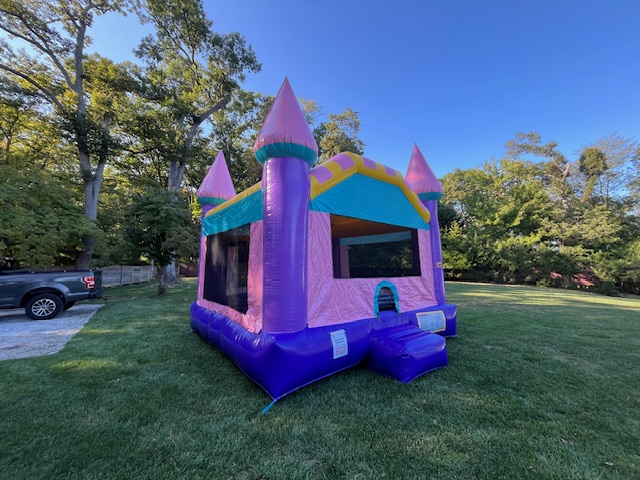
One more thing worth checking before you book: your backyard’s actual dimensions. A standard bounce house needs a minimum of 25 by 25 feet of total clear space, including the blower unit and safety clearance on all sides. In post-WWII Nassau County neighborhoods with smaller lots, that’s a real constraint. If you’re in Levittown or parts of Elmont, it’s worth measuring before you commit to a specific unit. In Massapequa, Syosset, or Great Neck, you’re usually working with more room and have more options.
Inflatable Rental Insurance: What It Covers and Why It Matters
When adults are using inflatables—obstacle courses, water slides, dunk tanks—the liability question comes up. Whose insurance covers what? It’s a fair thing to wonder, and the answer isn’t complicated once you understand how it works.
A legitimate rental company carries general liability insurance that covers the equipment and any negligence on the company’s part (improper setup, equipment failure, and so on). That insurance is separate from your homeowner’s policy. For a private backyard party, your homeowner’s coverage may extend to guest injuries on your property, but it’s worth a quick call to your insurer if you’re hosting a large event.
What a Certificate of Insurance Is and When You'll Need One
A Certificate of Insurance—usually called a COI—is a document that proves a company carries active liability coverage. It lists the policy details and can be issued with a specific organization named as an additional interested party. If you’re hosting an event at a school, a Nassau County park, a corporate venue, or any space where the property owner wants proof that your rental company is covered, a COI is what they’re asking for.
Not every rental company can produce one. Smaller operations, newer companies, or anyone running without proper commercial coverage won’t be able to hand you a COI with a school district’s name on it. That’s a problem if your event venue requires it—and most non-residential venues in Nassau County do.
We carry full general liability insurance and workers’ compensation, and we can provide a COI naming your organization, school, or municipality. It’s something we do regularly for corporate events, school carnivals, and block parties across Nassau County and Suffolk County. If your venue has a specific insurance requirement, ask us before you book—we’ll tell you exactly what we can provide and whether it meets what you need.
For large adult events, especially those held at venues outside your private property, it’s worth a conversation with your own insurer to understand where your coverage applies and where it ends. That’s just practical planning, and it takes one phone call.
The insurance question is one of the clearest ways to separate professional rental operations from informal ones. A company that has been operating for nearly two decades, runs out of a commercial warehouse, and routinely serves corporate clients, schools, and municipalities has to carry proper coverage. It’s not optional at that level.
Bounce House Safety Rules for Adult Parties
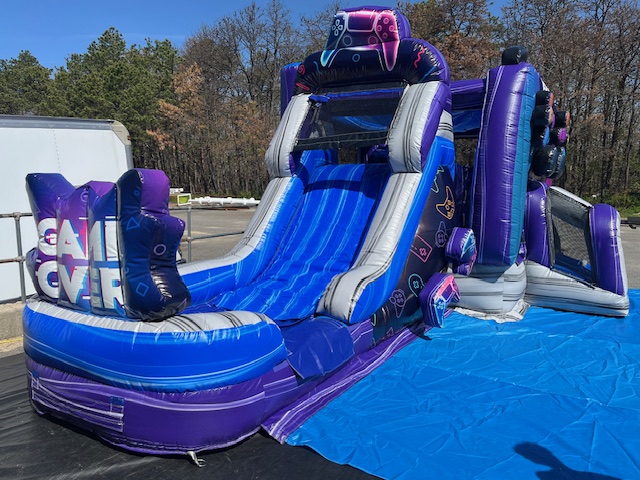
Adults use inflatables. Giant dual-lane water slides, full-length obstacle courses, dunk tanks, and interactive inflatables are built to handle adult use—with adult weight limits and adult-scale dimensions. If you’ve been to a graduation party, a corporate summer event, or a milestone birthday on Long Island in the last several years, you’ve probably seen one.
Roughly 80% of bounce house injuries come from improper setup or inadequate supervision, not from the equipment itself. That statistic changes how you should think about who you’re renting from. A properly anchored, correctly installed inflatable is a different thing than one that was dropped off and left without a safety check.
For private backyard parties, attendants are optional—you can hire staff if you want someone managing the inflatable, or you can handle it yourself. For larger events (corporate gatherings, block parties, school carnivals, community festivals), we provide trained attendants for all bouncers, obstacle courses, and slides. That’s how we operate those types of events.
The practical safety rules for adult inflatable use are straightforward. Mixed-age groups need to be managed carefully—adults and small children shouldn’t be in the same bounce house at the same time. Weight limits are posted on every unit and exist for a reason. For water slides, closed-toe shoes or bare feet are fine; loose clothing that can catch is not. Weather matters too—high winds are a genuine safety concern for anchored inflatables, and a professional company will have a clear policy on what conditions warrant taking a unit down.
All of our inflatables are inspected and cleaned after every single rental. Every unit has built-in safety nets, entrance ramps, and escape openings. Every electrical connection runs through GFCI protection. We anchor everything with a system designed for Long Island’s coastal wind conditions, which are not the same as inland conditions. These are the baseline of how professional inflatable rentals are supposed to work.
Planning a Backyard Party in Nassau County? Here's Where to Start
The permit question, the HOA check, the insurance documentation—none of it is as complicated as it sounds once you know what to look for. Most Nassau County backyard parties don’t require anything beyond a quick measurement and a call to your HOA if you live in a governed community. The events that need more paperwork (parks, schools, block parties) just need a rental company that’s set up to handle it.
If you’re still in the planning stage and want to know whether your yard can fit what you’re thinking, what documentation your venue requires, or what adult-appropriate options we carry, reach out to The Big Bounce Theory. We’ve been doing this across Nassau County long enough to have seen most of the situations that come up—and we’d rather answer your questions before you book than after.