Summary:
You’ve decided you want an inflatable at your next party. Smart call. Now comes the part nobody warns you about: figuring out which one. A bounce house and an obstacle course are not the same thing, and booking the wrong one — even from a great company — can turn a well-planned party into a logistical headache. The wrong size for your yard, the wrong style for your age group, the wrong vibe for the crowd. It happens more than you’d think. This guide is here to make sure it doesn’t happen to you. We’ll walk through the key differences, who each option is actually built for, and what your Nassau County backyard or event space can realistically handle.
Inflatable Obstacle Course vs. Bounce House: What's Actually Different?
At first glance, they’re both big, inflatable, and loud in the best possible way. But they serve completely different purposes. A bounce house is an enclosed jumping space — kids go in, jump around, and come out when they’re done. It’s free-form, low-structure, and great for younger children who just want to move without any particular goal in mind.
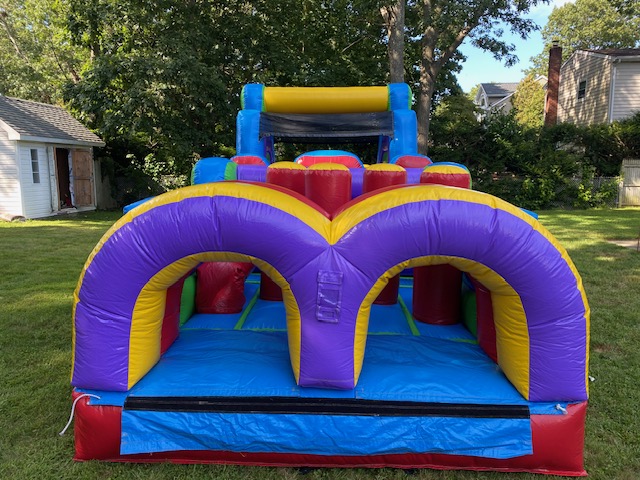
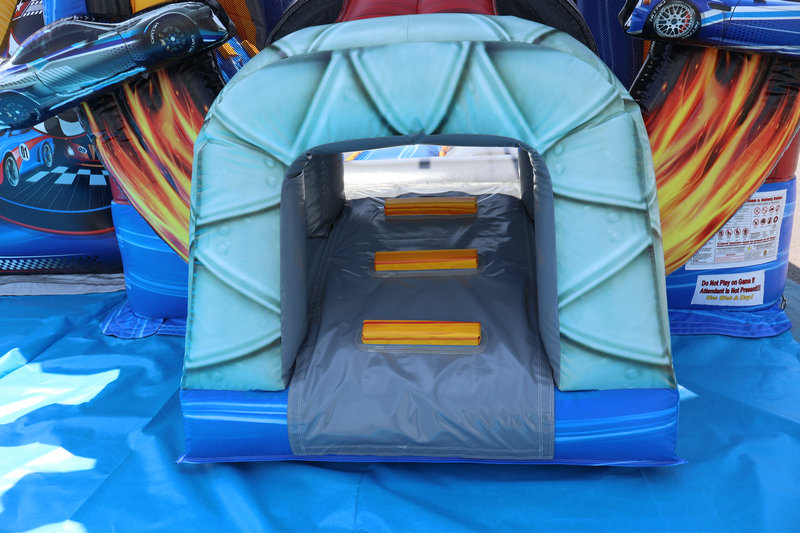
An inflatable obstacle course is a different experience entirely. There’s a start, a finish, and a series of physical challenges in between — crawling through tunnels, climbing over walls, squeezing past pop-ups, and sliding down at the end. It’s built around competition and progression, not just jumping. That distinction matters a lot when you’re trying to match the right rental to the right crowd.
Which Option Keeps Kids Entertained Longer?
Engagement duration is one of the most underrated factors in this decision, and it’s one that parents almost always underestimate. A bounce house is genuinely excellent for younger kids — ages three through seven tend to stay in one for a long time because the simple act of jumping is endlessly entertaining at that age. They don’t need a finish line or a scoreboard. The bounce itself is the point.
Once kids hit around eight or nine, that changes. Tweens and older elementary-age kids will bounce for a few minutes and then drift. Not because they’re bored in a general sense, but because there’s nothing to work toward. The obstacle course solves that problem directly. Racing a friend through a 50-foot course — crawling, climbing, sliding — holds attention in a way that open bouncing simply doesn’t for that age group. The competitive element keeps them coming back for another run, and another, and another.
For mixed-age parties, which are the norm at most Nassau County birthday parties and community events, this is where things get genuinely complicated. You’ve got a six-year-old cousin and a twelve-year-old neighbor and everyone in between. Neither a pure bounce house nor a pure obstacle course is a perfect fit for that range. That’s where combo units come in — and we’ll get to those.
One more practical note on engagement: obstacle courses naturally manage crowd flow better than bounce houses. With a bounce house, everyone enters and exits through the same opening, which creates a bottleneck when you’ve got 30 or 40 kids waiting. An obstacle course moves participants from one end to the other, keeping the line moving and the energy up. For school field days and community events at places like Eisenhower Park in East Meadow, NY, that throughput difference is significant.
Bounce House for Kids: What Age Range Does It Actually Fit?
The honest answer is that bounce houses are best designed for children between three and ten, with the sweet spot sitting firmly in the three-to-seven range. Standard bounce houses — the enclosed, netted units with padded floors and entrance ramps — are built with younger kids in mind. The walls keep them contained, the dimensions are manageable, and the activity level matches what toddlers and early elementary kids are actually capable of and interested in.
A 13-by-13-foot unit typically holds six to eight children under age eight comfortably. A 15-by-15-foot unit, which is the most common size for mixed-age birthday parties, holds eight to ten kids and works well when the majority of your guests are under ten. These are the units that make sense for a backyard birthday party in Levittown, NY or Rockville Centre, NY where the guest list is mostly kindergarteners and first-graders.
What bounce houses are not great for: parties where the average age skews older. If your child is turning eleven and the invite list is full of classmates, a standard bounce house will feel underwhelming within about twenty minutes. That’s not a knock on the equipment — it’s just the wrong tool for that crowd.
It’s also worth noting that bounce houses are not exclusively for children. Adult-sized units exist, and for the right event — a block party in Garden City, NY, a company picnic, a graduation party — they can be a genuine hit with older guests who aren’t expecting them. But for most residential birthday parties with a younger guest list, the classic bounce house is exactly what it sounds like: a contained, safe, high-energy space for kids to wear themselves out.
Obstacle Course for Kids: Space, Setup, and Who It's Really Built For
Obstacle courses are the right call when you need something that works for older kids, larger groups, or events where the entertainment needs to carry the day on its own. They’re physically demanding in a fun way, they create natural competition, and they give kids a reason to keep cycling through instead of wandering off to find something else to do.
They do require significantly more space than a bounce house, and that’s the first thing to think through honestly before booking one. Getting the space math right before delivery day is the difference between a smooth setup and a last-minute scramble.
How Much Space Does an Inflatable Obstacle Course Need?
This is the question that matters most, and it’s the one people most often skip until it’s too late. Obstacle courses range from compact 20-foot units to full 75-foot setups, and the space requirements scale accordingly. A 50-foot course that’s 15 feet wide needs a clear setup area of at least 60 by 25 feet — and that’s before you account for the three to five feet of clearance required on all sides for safe anchoring and entry and exit.
For context, a standard bounce house needs approximately 15 by 15 feet of flat space plus three to six feet of clearance on all sides. That fits in most Nassau County backyards without much trouble. A full obstacle course is a different calculation entirely, and a typical Long Island backyard — especially in denser communities like Elmont, NY, Valley Stream, NY, or Franklin Square, NY — may not have that kind of unobstructed flat space available.
This doesn’t mean obstacle courses are off the table for residential events. It means you need to measure your actual yard before booking, not estimate. We help customers work through this before the truck leaves our warehouse. You’ll need to know your total clear area, your gate width (at least three feet for delivery access), and whether there’s electrical power within 100 feet for the blower unit. Those three things determine whether a given unit works for your specific space.
For events at Nassau County parks — Eisenhower Park in East Meadow, NY, which is one of the largest county parks in the country — space is rarely the limiting factor. Obstacle courses thrive in open park settings where you’ve got room to run the full length and set up additional rentals alongside them. School fields, community center parking lots, and church grounds are similarly well-suited. If your event is happening in one of those settings rather than a private backyard, an obstacle course becomes much easier to accommodate and much more impactful for the crowd.
One thing worth knowing about coastal Nassau communities like Long Beach, NY, Atlantic Beach, NY, and Oceanside, NY: wind is a real factor near the water. Larger inflatables — especially obstacle courses — require proper anchoring, and a vendor who knows how to secure equipment in those conditions is not a nice-to-have. It’s a necessity. This is part of why local experience matters as much as inventory.
When the Answer Is Neither — and a Combo Unit Is What You Actually Need
Here’s the scenario that plays out constantly at Nassau County birthday parties: the guest list spans ages four through thirteen, the backyard is a reasonable size but not enormous, and the parent booking the rental is trying to find one thing that keeps everyone happy. A bounce house alone won’t hold the older kids. A full obstacle course may be more than the space can handle, and it’s not ideal for the youngest guests either.
That’s the exact problem combo bounce houses were designed to solve. A combo unit combines the jumping room of a bounce house with a climbing wall, a slide, a basketball hoop, and in some cases built-in obstacles — all in a single footprint. It gives the little ones a safe, enclosed space to jump while giving older kids something to climb, shoot, and compete over. One rental, one delivery, one setup, and something for everyone.
Combo units typically require around 20 by 30 feet of clear space, which puts them in a more manageable range than a full obstacle course while still offering significantly more than a standard bounce house. For many Nassau County backyards, that’s the sweet spot.
For larger events — school field days in Bethpage, NY, PTA carnivals in Merrick, NY, corporate picnics in Uniondale, NY — renting both a bounce house and an obstacle course from the same vendor is often the cleanest solution. Younger kids go to the bounce house, older kids race the obstacle course, and the event has two distinct activity zones instead of one. When everything comes from a single vendor, there’s one delivery window, one setup crew, one insurance document, and one point of contact if anything comes up. That logistical simplicity is worth more than most people realize until they’ve tried coordinating two separate rental companies for the same event.
We’ve been doing this across Nassau County since 2007, and the parties that run the smoothest are almost always the ones where the entertainment was matched to the actual crowd — not just whatever seemed fun in the moment. The right unit for your event exists. It just takes a few honest questions to find it.
How to Choose the Right Inflatable Rental for Your Nassau County Event
If your guests are mostly younger kids and your backyard is a standard suburban lot, a bounce house is probably your answer. If you’ve got older kids, a larger space, or a crowd that needs something to compete over, an obstacle course will hold their attention far longer. And if your guest list is mixed — which it usually is — a combo unit or a combination of both is worth a serious look.
The wrong choice isn’t a disaster. But it’s avoidable, and the fix is simpler than most people think: know your space, know your crowd, and talk to someone who’s seen both go right and wrong at enough Nassau County events to give you a straight answer.
The Big Bounce Theory has been helping families, schools, and organizations across Nassau County get this decision right for nearly two decades. Reach out before you book — we’ll help you figure out exactly what fits.