Summary:
Every summer across Nassau County — from Levittown backyards to Massapequa block parties to Garden City school field days — someone books a water slide and ends up with the wrong one. Too tall for the kids. Too long for the yard. Or a flat slip-n-slide at a teen graduation party where nobody touched it after the first five minutes.
It’s not a vendor problem. It’s a format problem. Most people don’t realize there are five distinct types of water slide rentals, and each one is built for a completely different situation. Get it right and your event runs itself. Get it wrong and you’re the one answering questions all afternoon.
Here’s how to get it right.
Water Slide Rental Types: What's Actually Out There
The term “water slide rental” gets used as a catch-all, but it covers a surprisingly wide range of equipment. A flat inflatable slip-n-slide and a 22-foot dual-lane tower are both technically water slides — but they serve completely different events, require different amounts of space, and work for different age groups.
Before you can pick the right one, you need to know what the options actually are. There are five main formats: flat slip-n-slides, single-lane inflatable slides, large towering slides, double-lane inflatable slides, and combo bounce-and-slide units. Each one has a sweet spot — an event type, an age range, and a space requirement where it genuinely shines.
Flat Slip-N-Slides vs. Inflatable Water Slides: What's the Difference?
This is the question we hear most often, and it’s worth answering clearly because the two formats get confused constantly.
A flat slip-n-slide is a ground-level inflatable lane — typically 20 to 40 feet long — where riders get a running start and slide on their stomach or back into a shallow pool at the end. There’s no climbing involved. The whole thing sits flush with the ground. It’s fast, it’s simple, and it works well for kids who aren’t quite ready for a tall slide. It also works surprisingly well for adults at casual backyard parties, because there’s something genuinely fun about a running slide that doesn’t require a ladder. Space-wise, you need a long, flat stretch of grass — ideally 40 to 50 feet of clearance including the run-up zone.
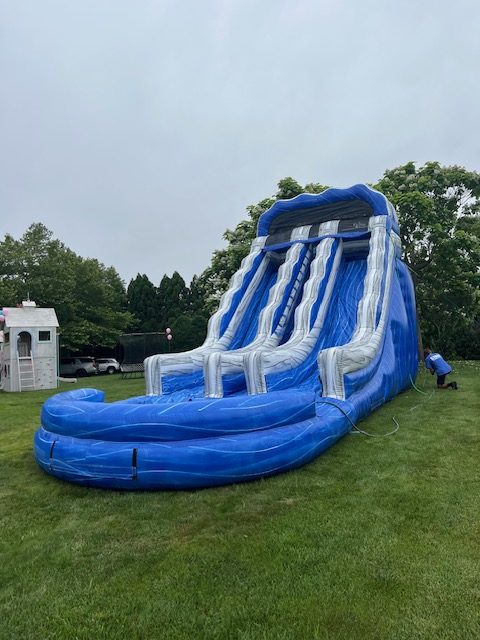
An inflatable water slide is a different product entirely. It’s a freestanding structure — typically 10 to 22 feet tall — with a climbing wall or steps on one side, a slide lane on the other, and a splash pool at the bottom. Riders climb up and slide down, over and over. These are the units you see at birthday parties and school field days. They’re more visually impressive, they handle higher throughput (more kids cycling through at once), and they’re better suited to events where kids will be using the equipment for several hours. The tradeoff is that they require more vertical clearance and a different footprint than a flat slip-n-slide.
Knowing which format you actually need comes down to three things: who’s using it, how long the event runs, and what your space looks like. A 6-year-old’s birthday party in a Wantagh backyard with 15 kids is a different situation than a Hicksville school field day with 200 students rotating through stations.
Which Water Slide Size Is Right for Your Nassau County Backyard or Event Space?
This is where a lot of Nassau County bookings go sideways. The county’s suburban lots vary enormously — a yard in Valley Stream or Elmont might give you 30 feet of usable grass, while a property in Oyster Bay or Jericho might have room for multiple setups. The slide that works perfectly in one backyard won’t fit in another.
As a general rule, you need to add at least three to four feet of buffer on every side of the slide’s listed dimensions. A mid-sized slide that’s 25 feet long and 15 feet wide needs roughly 33 by 22 feet of clear, flat space — and that’s before you account for the blower unit, the hose connection, and the area where kids land and walk away from the splash pool. Tighter than that and the setup becomes a safety issue.
For smaller Nassau County lots — the kind common in Freeport, Oceanside, or East Meadow — a 15-foot single-lane slide or a flat slip-n-slide is often the smarter call. They’re easier to position, they require less overhead clearance, and they’re genuinely appropriate for the 5-to-10 age range that makes up most backyard birthday parties. Trying to squeeze a 22-foot tower into a modest suburban yard creates problems for our crew during setup and creates hazards during the event.
For larger events — school field days in Rockville Centre or Bethpage, community block parties in Merrick or Bellmore, or graduation parties with a mix of teens and adults — the calculus flips. A single-lane 15-footer isn’t going to hold the attention of 80 middle schoolers for three hours. That’s where larger towering slides and dual-lane options earn their place. The rule of thumb for a 35-foot slide is a minimum footprint of roughly 45 by 20 feet including all clearance zones. If you’re not sure whether your space qualifies, that’s exactly the kind of question to ask when you call — we’d rather sort it out before delivery day than show up and have to problem-solve on the spot.
Age matching matters just as much as space. For kids between 5 and 12, slides in the 10-to-18-foot range are the right fit. For teens and adults, you’re looking at 17 feet and taller, dual-lane racing slides, or water obstacle courses. Getting that match right is the difference between equipment that gets used all day and equipment that sits idle after the first half hour.
Large Water Slide Rental Options: When Bigger Actually Makes Sense
There’s a tendency to default to the biggest slide available on the assumption that bigger equals better. Sometimes that’s true. A 22-foot dual-lane slide at a school field day in Plainview or a graduation party in Great Neck is genuinely the right call — it handles volume, it works for older kids and adults, and it becomes the visual centerpiece of the event.
But “big” only works when the space, the crowd, and the event format support it. The question isn’t whether a large slide is impressive. It’s whether it’s the right tool for what you’re actually trying to accomplish.
Double Water Slide Inflatable: Is a Dual-Lane Slide Worth It?
A dual-lane inflatable water slide — sometimes called a double water slide — has two side-by-side slide lanes so two riders can go at the same time. That sounds like a minor upgrade, but the operational difference at an actual event is significant.
At a birthday party with 20 kids, a single-lane slide creates a line. Kids wait, get restless, and start wandering. A dual-lane slide cuts wait time roughly in half and turns the slide into a racing activity — which, for kids between 8 and 14, is dramatically more engaging than just sliding down alone. The competitive element keeps them coming back. Some dual-lane setups also include an extended slip-n-slide section at the base, creating a combined experience that can run 50 to 65 feet of total sliding surface from top to bottom.
For school field days — which are a major part of the late May and June calendar across Nassau County school districts — dual-lane slides are often the only format that makes operational sense. When you have 150 to 300 students rotating through activity stations, throughput matters. A single-lane slide becomes a bottleneck. A dual-lane slide keeps the line moving and keeps the energy up.
The tradeoff is space and lead time. Dual-lane slides are larger pieces of equipment that require more clearance — plan for a significantly wider footprint than a single-lane unit of the same height. And because they’re in high demand during peak season, they book out faster than almost anything else in our inventory. If you’re planning a field day or a large community event for June or July, locking in your date months in advance isn’t overcautious — it’s just how Nassau County summer scheduling works.
Cheap Water Slide Rentals: What the Price Actually Reflects
Price is usually the third or fourth thing people ask about — after size, format, and availability. But it’s worth addressing directly because the water slide rental market has a real transparency problem.
The sticker price on a cheap water slide rental is rarely the number you actually pay. Across the industry, it’s common to see base rental prices that don’t include delivery, setup, teardown, the ground tarp, the hose connection fee, or a weekend surcharge. A rental that looks like a straightforward deal can end up significantly more expensive once those line items appear on the invoice.
Water slide rentals under $200 do exist, but they typically reflect one of a few situations: a very small, basic unit, a weekday booking in the off-season, or a price that doesn’t include everything you’ll actually need on the day of the event. If you’re comparing quotes and one number looks noticeably lower than the others, the right move is to ask specifically what’s included — delivery, setup, teardown, the blower, extension cords, ground tarps, and hose hookup. A complete, all-in quote is the only number worth comparing.
There’s also the equipment condition factor. Commercial-grade water slides — the kind built for repeated professional rental use — are constructed differently than the consumer inflatables you’d find at a big-box store. Heavier-gauge vinyl, reinforced stitching, proper anchor systems, safety nets, non-slip entry ramps, and splash pools at the base are standard on commercial units. The CPSC has documented that the majority of inflatable amusement injuries are attributable to improper setup and inadequate equipment — not random accidents. Who sets it up and what they’re setting up both matter.
We’ve been doing this since 2007. Our equipment goes through annual New York State inspection and certification, gets cleaned and sanitized between every rental, and is delivered and set up by a professional crew — not dropped at the curb. That’s not a premium add-on. That’s what a complete rental is supposed to look like.
Ready to Book a Slip N Slide Rental in Nassau County?
The right water slide rental isn’t the biggest one, the cheapest one, or the one with the best photo. It’s the one that actually fits your space, suits your guests’ ages, handles your event’s volume, and shows up on time in the condition it was described.
Nassau County summers are short and weekends fill up fast — especially in June and July when school field days, graduation parties, and block parties all compete for the same delivery slots. If you have a date in mind, the worst outcome is waiting too long and finding out the equipment you wanted is already booked.
Give The Big Bounce Theory a call. We’ll help you figure out exactly what you need — and make sure the day goes the way you planned it.