Summary:
You’ve got a field day coming up, a school full of kids, and a budget that needs to stretch across the whole afternoon. You already know the usual options — bounce houses, water slides, carnival games. But every year, the one rental that gets the loudest reaction, holds the longest lines, and keeps kids engaged from start to finish is the water obstacle course. It’s not complicated to understand why. What is complicated — at least for first-time planners — is figuring out the logistics: how much space you actually need, whether your vendor can provide the right insurance paperwork, and how to keep 200 students cycling through without chaos. That’s what this guide is for.
What Are Water Inflatables — and What Makes an Obstacle Course Different?
Most people picture a water slide when they think of inflatable water rentals — one kid at a time, a single lane, a splash pool at the bottom. A water obstacle course is a fundamentally different experience. Instead of a straight shot down a slide, participants move through a sequence of challenges: climbing walls, crawl tunnels, pop-up obstacles, and slippery inclines, all leading to a slide finish. The whole structure is designed to be run, not just ridden.
The key distinction for field day planning is that a water obstacle course is built for competition and throughput. In a dual-lane configuration, two students race side by side, which creates a natural spectator moment — the kids waiting in line are watching, cheering, and already hyped for their turn. That self-sustaining energy is something a standard water slide simply can’t replicate, and it matters a lot when you’re managing a large group with limited adult supervision per station.
How Does a Water Obstacle Course Actually Work at a Field Day?
The mechanics are straightforward once you’ve seen it in action. Students line up at the start, two at a time in a dual-lane setup, and race through the full obstacle sequence — climbing, crawling, navigating splash zones — before sliding into the finish. Each run typically takes around two to three minutes.
In a dual-lane configuration, that means you can cycle roughly 20 runs per lane per hour, which translates to approximately 40 students per hour through a single unit. For a school with 200 kids rotating through multiple stations, that’s a very manageable throughput.
The competitive element also solves a real supervision problem. Because there’s always a race happening and a clear winner at the end, kids self-organize into a queue without much prompting. Teachers and volunteers can focus on keeping the line orderly rather than managing boredom or restlessness. That’s not a small thing when you’re running a full field day with multiple stations simultaneously.
Most field day organizers in Nassau County build their rotations in 20- to 30-minute blocks. A water obstacle course fits cleanly into that structure — one class moves through, the next class steps in, and the line never really goes cold. The spectator energy carries over between groups, which keeps the overall atmosphere high even during transitions.
One thing worth understanding before you book: a water obstacle course needs a water source nearby. The unit connects to a standard garden hose to keep the surfaces wet throughout the event. If your school field or park venue doesn’t have a water hookup within a reasonable distance of the setup location, that’s worth confirming in advance. It’s a simple thing to plan for, but it can become a headache if it’s discovered the morning of the event.
Is a Water Obstacle Course the Right Fit for Your Age Group?
This is one of the most common questions we hear from school administrators, and it’s the right one to ask. The short answer is that water obstacle courses work well across a wide age range — elementary through middle school — but the specific configuration matters.
For younger elementary students, the key factors are obstacle height, tunnel diameter, and the overall length of the course. A course that’s appropriately scaled for younger kids allows them to move through confidently without feeling overwhelmed by the size of the structure. For older elementary and middle school students, a longer course with more challenging obstacles — higher climbing walls, tighter crawl sections, more competitive lane setup — tends to land better because it actually feels like a challenge rather than a walk-through.
When you’re talking to us about a Nassau County school field day, give us the grade range and approximate age spread of your students. We’ve been delivering to Nassau County school events since 2007, and the age-appropriateness question is one we walk through with every school client — it directly affects which unit we recommend and how the setup is configured.
It’s also worth noting that water obstacle courses are not exclusively for younger kids. They hold up well at middle school events precisely because the racing element adds a competitive dimension that older students respond to. A bounce house might feel too young for a seventh grader; a head-to-head obstacle course race does not. That crossover appeal is one of the reasons water obstacle courses have become a field day staple across Nassau County school districts, from elementary schools in Garden City to middle schools in Levittown and Massapequa.
Inflatable Slide Rental vs. Water Obstacle Course: Which One Should You Book?
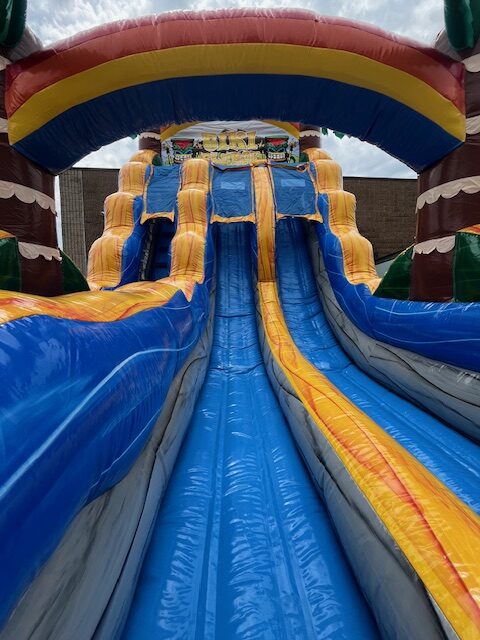
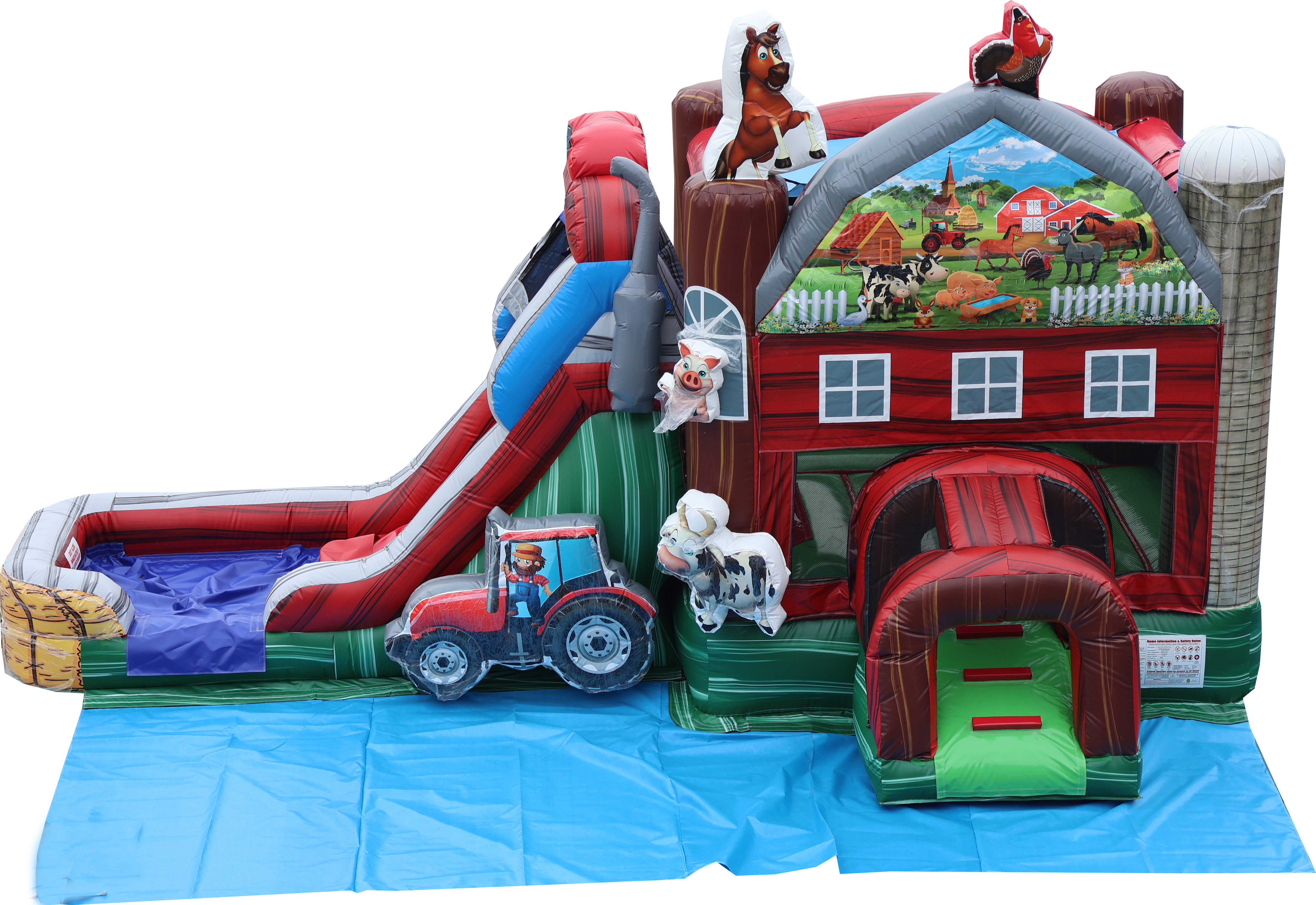
If you’re deciding between an inflatable slide rental and a water obstacle course for your field day, the honest answer is that it depends on your group size, your available space, and what kind of experience you’re going for. A large inflatable water slide is a great option for smaller events or younger age groups where the goal is simple, high-energy fun. A water obstacle course is better suited to large groups where engagement, throughput, and competitive energy are the priorities.
For most Nassau County field days — where you’re managing 150 to 300 students across a full afternoon — the obstacle course tends to deliver more value per hour because it keeps more kids actively engaged at once. Many schools rent both as part of a broader station lineup.
How Much Space Does a Large Inflatable Water Slide or Obstacle Course Actually Need?
Space anxiety is real, and it’s one of the most common reasons event planners hesitate before booking a large inflatable. The fear is understandable: you have a mental picture of your school field or park venue, and you’re not sure whether a 50-foot inflatable is going to fit without crowding out every other activity.
Here’s what’s useful to know. A large inflatable water slide typically requires a footprint in the range of 20 to 30 feet in length, plus clearance on all sides for safe entry, exit, and anchoring. A full water obstacle course runs longer — often 40 to 80 feet depending on the specific unit — and similarly requires clearance zones on all sides, plus access to a water source. The total footprint including clearance is typically larger than the unit itself, so the usable space you need is meaningfully more than just the length of the inflatable.
The practical question is whether your venue can accommodate that footprint while still leaving room for other field day stations. Nassau County’s school athletic fields are generally well-suited for large inflatable setups — the flat terrain that characterizes most of the county means there are rarely grading or drainage complications that you’d encounter in hillier parts of the state. Town parks in Wantagh, Seaford, and Merrick, as well as larger venues like Eisenhower Park in East Meadow, regularly host setups of this scale.
When you call to book with us, give us the approximate dimensions of your available space and we’ll tell you exactly which units fit and how to orient them for the best traffic flow. We’ve set up at enough Nassau County school fields and parks to have a good sense of what works where. The goal is never to squeeze something in — it’s to make sure the setup serves the event rather than complicating it.
What Insurance Documentation Do Nassau County Schools and Parks Require?
This is the question that catches a lot of first-time school event planners off guard, and it’s worth understanding before you get too far into the booking process. Nassau County parks — including Eisenhower Park in East Meadow and town parks throughout the county — require a Certificate of Insurance from the rental company, with the park or municipality listed as an additional insured. Many Nassau County school districts have the same requirement when outside vendors are involved.
What that means in practice is that your rental company needs to carry general liability insurance at an appropriate coverage level and be able to issue a COI that names your school district or venue specifically. If the company you’re booking with can’t produce that document, you risk having the vendor turned away at the gate on the day of the event — or having the event shut down before it starts.
We’ve been handling COI requests for Nassau County schools, parks, and municipalities for over 18 years. It’s a routine part of our process, not a special request. When your school administrator or facilities coordinator asks for the insurance documentation, we already know what they need and can get it to them quickly.
Beyond the COI, we carry full general liability insurance and workers’ compensation — which matters not just for compliance, but for your peace of mind as the event organizer. If something goes wrong on the day, you want to know that the vendor you hired is properly covered and that your school or organization isn’t left exposed. That’s not a small thing when you’re the one who signed off on the rental. A huge inflatable water slide or a full obstacle course setup involves real equipment, real kids, and real stakes — and the insurance question deserves a real answer before you book.
Ready to Book a Water Obstacle Course for Your Nassau County Field Day?
A water obstacle course is one of those rentals that earns its place every time — it engages large groups, runs efficiently, and creates the kind of competitive energy that makes a field day feel like an actual event rather than a loose collection of activities. But the logistics matter, and the details you sort out before booking are what determine whether the day goes smoothly or sideways.
Get clear on your space, confirm your water access, know what insurance documentation your venue requires, and book earlier than you think you need to. Popular field day dates in Nassau County — particularly in late May and early June — fill up fast, and the best dates go to organizers who plan ahead.
If you have questions about what fits your space, which unit works for your age group, or what the COI process looks like for your specific Nassau County school or park, reach out to The Big Bounce Theory. We’ve been doing this on Long Island since 2007, and we’re happy to walk through the details with you.