
Summary:
You found a few options online, the prices look reasonable, and then you call and suddenly there’s a delivery fee, a weekend premium, and a deposit policy that wasn’t mentioned anywhere on the site. Sound familiar?
Water bounce house pricing in Nassau County isn’t complicated — but it’s also not as straightforward as a single number on a product page. There are real factors behind what you’ll pay, and understanding them upfront saves you from surprises on the day of your event. Here’s what actually drives the cost, what your rental contract should spell out, and why the insurance question matters more than most people think.
What Affects Water Bounce House Rental Pricing in Nassau County
The base price of a water bounce house rental is just the starting point. What you actually pay depends on a handful of factors that stack on top of each other — and in a market like Nassau County, where summer weekends fill up fast, those factors carry real weight.
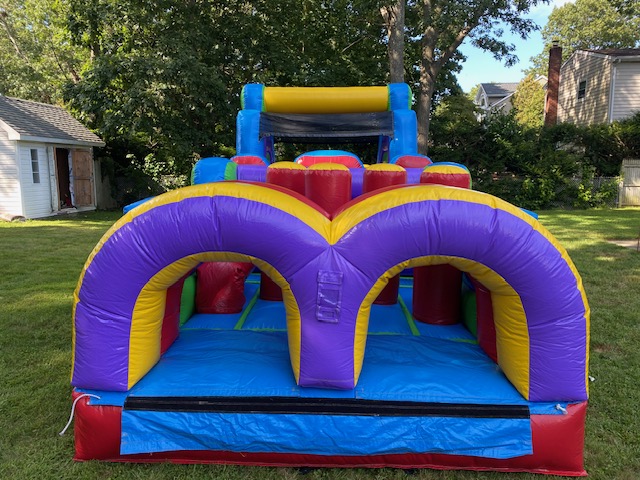
Size is the most obvious driver. A single-lane water slide combo runs differently than a large dual-lane unit that takes up half a backyard. Larger units cost more to purchase, more to transport, and more to set up — and that’s reflected in the rental price. Duration matters too. Most rentals are priced for a 4–6 hour window. If your event runs longer, expect that to affect the quote.
How Delivery Distance, Season, and Add-Ons Change the Final Number
Delivery distance is a cost that surprises people more than almost anything else. We serve all of Nassau County — from Levittown to Great Neck, from Oceanside to Port Washington — and that means covering real ground. Fuel, labor, and time are baked into that delivery fee, and it’s not unreasonable. What is unreasonable is when that fee isn’t disclosed until checkout. In Nassau County, delivery fees typically run anywhere from $50 to over $150 depending on how far we’re traveling.
Seasonal demand is the other big variable that doesn’t get talked about enough. Nassau County’s water inflatable season runs roughly Memorial Day through Labor Day. That’s a tight window — maybe 14 or 15 prime weekends — and quality operators book up 6 to 8 weeks out during peak summer. When demand is high and availability is limited, prices reflect that. If you’re planning a July Fourth weekend party in Wantagh or a mid-August birthday in Rockville Centre, you’re competing with every other family on Long Island who had the same idea. Booking early isn’t just good advice — it’s the only way to guarantee you get the unit you want.
Add-ons are the third layer. Tents, tables, chairs, concession machines, and attendants all affect the total. Some of those are optional upgrades. Others — like a trained setup crew or an on-site attendant for a school or park event — aren’t optional at all, and you should want them included. A water bounce house that gets dropped in your backyard with no professional setup isn’t just inconvenient. It’s a safety issue.
One more thing worth knowing: water inflatables carry higher insurance risk ratings than standard dry bounce houses, which means our insurance costs more to maintain. That gets factored into pricing too. When you see a significantly lower price from a competitor, it’s worth asking what they’re cutting to get there.
What Does a $99 Bounce House Rental Actually Get You?
The $99 bounce house rental exists. You’ve probably seen it advertised. And it’s worth understanding what that price typically includes — and what it doesn’t — before it shapes your expectations for everything else.
At that price point, you’re almost always looking at residential-grade equipment. That means thinner vinyl, fewer built-in safety features, lower weight limits, and units that have typically been rented out dozens of times without the kind of maintenance a commercial-grade inflatable receives. Residential units aren’t built for repeated commercial use. They wear faster, they look it, and they carry more risk.
What’s also usually missing at that price: liability insurance documentation. If you’re hosting at a Nassau County park, a school, or any venue that requires a Certificate of Insurance, a $99 operator almost certainly cannot produce one. That’s not a minor inconvenience — it means your event doesn’t happen at the venue you planned. Nassau County parks and school districts don’t make exceptions. They require a COI with the venue listed as additional insured, and they need it days before the event. If your vendor can’t provide that paperwork, you’re starting over.
There’s also the question of what happens when something goes wrong. A company without proper insurance leaves you exposed. If a child is injured on an uninsured inflatable at your event, the liability question gets complicated fast. New York has one of the higher litigation rates in the country. That’s not a reason to panic — it’s a reason to make sure your rental company carries real coverage and can prove it.
When the price is dramatically below market rate, something is usually different. Understanding what that something is before you book is just smart.
Bounce House Rental Contracts: What You're Actually Agreeing To
Most people click through a rental agreement without reading it. That’s understandable — it’s a bounce house, not a mortgage. But the contract is where the important stuff lives: what happens if it rains, who’s responsible if the equipment is damaged, and what you’re owed if we cancel on you.
A well-written rental agreement protects both sides. It should be clear, not buried in legal language designed to confuse. If you read a contract and can’t tell what the weather cancellation policy is, that’s a problem — and it’s one you’ll feel the day of your event if the forecast turns.
What a Bounce House Rental Agreement Should Spell Out Before You Sign
The weather policy is the first thing to look for. Long Island summers are beautiful and unpredictable in equal measure. Afternoon thunderstorms roll through Nassau County with almost no warning, and a water bounce house that was set up at noon can be sitting in a downpour by three o’clock. What happens to your payment in that scenario depends entirely on what the contract says.
Some agreements allow you to cancel before a certain time on the morning of delivery — typically before 7 AM — and receive a refund of your deposit. Others are stricter. Once the unit is delivered and set up, most operators consider payment due regardless of what the weather does afterward. That’s not unreasonable, but you need to know it going in. The worst outcome is assuming you’ll get your money back because it rained, only to find out the contract says otherwise.
Beyond weather, look at what the contract says about damage. Commercial-grade inflatables are built to take a beating, but they’re not indestructible. Most agreements distinguish between normal wear and damage caused by misuse — things like sharp objects, silly string, or exceeding the weight limit. You’re generally not on the hook for normal wear. You are responsible for damage caused by guests who didn’t follow the rules. Understanding that distinction matters, especially if you’re hosting a larger event.
Cancellation terms — from our side — should also be addressed. We have a clear policy about what happens if we need to cancel due to equipment failure or an emergency. You should know whether you get a full refund, a credit, or a replacement unit. If that scenario isn’t addressed in the contract, ask about it before you sign.
Finally, look at setup requirements. Some contracts specify that the area needs to be clear of debris, within a certain distance of a water source, and on a flat surface. If your backyard in Merrick or Bellmore has a slope or limited hose access, that’s worth discussing before the crew shows up.
Bounce House Rental Insurance: What It Covers and Why Nassau County Events Require It
Insurance is the part of a bounce house rental that nobody wants to think about until they need it. But in Nassau County specifically, it’s not optional for a wide range of events — it’s a hard requirement.
Nassau County parks require a Certificate of Insurance before any commercial vendor, including inflatable rental companies, can set up on public property. School districts across Nassau County — from the Levittown Union Free School District to the Garden City School District — require a COI with the school district listed as additional insured before allowing any inflatable setup on school grounds. Churches, community centers, and corporate venues typically have the same requirement. If you’re planning a PTA carnival, a block party at a community park, or a corporate summer picnic anywhere in Nassau County, the question isn’t whether you need insurance documentation — it’s whether your vendor can produce it.
What that documentation looks like is a Certificate of Insurance naming your venue as an additional insured on the rental company’s liability policy. Industry standard for inflatable operators is $1 million per occurrence in general liability coverage. That certificate needs to be in the venue’s hands typically 7 to 14 days before the event. If your vendor can’t generate that document with your venue’s name on it, you’re either scrambling to find a new vendor or losing your venue deposit.
We’ve been providing COI documentation for Nassau County schools, parks, and corporate venues since 2007. It’s a routine part of what we do — not a special request. We carry full liability coverage, workers’ compensation, and we can have the certificate to your venue contact quickly once we have the venue name and address. For larger public events, we also provide trained on-site attendants who stay with the equipment throughout the event. That’s not just good service — for school and park events, it’s the right way to operate.
If a rental company tells you they’re “fully insured” but can’t produce a COI with your venue’s name listed, that coverage doesn’t help you. Ask for the documentation before you book, not after.
How to Book a Water Bounce House Rental in Nassau County With No Surprises
The short version: know what you’re paying for, read the contract before you sign it, and make sure your vendor can produce insurance documentation if your venue requires it. Those three things will keep you out of 90% of the situations that turn a fun event into a frustrating one.
Peak summer weekends in Nassau County book up fast — often 6 to 8 weeks out for the units people actually want. If your event is in June, July, or August, the time to call is now, not two weeks before the party.
We’ve been handling events across Nassau County, Suffolk County, and the Hamptons since 2007. Every inflatable we rent is commercial-grade and purchased new. Every rental comes with professional setup by trained staff, and every quote includes honest pricing with no hidden fees. If you have questions about pricing, contracts, or what your venue needs from an insurance standpoint, reach out — we’ll give you a straight answer.